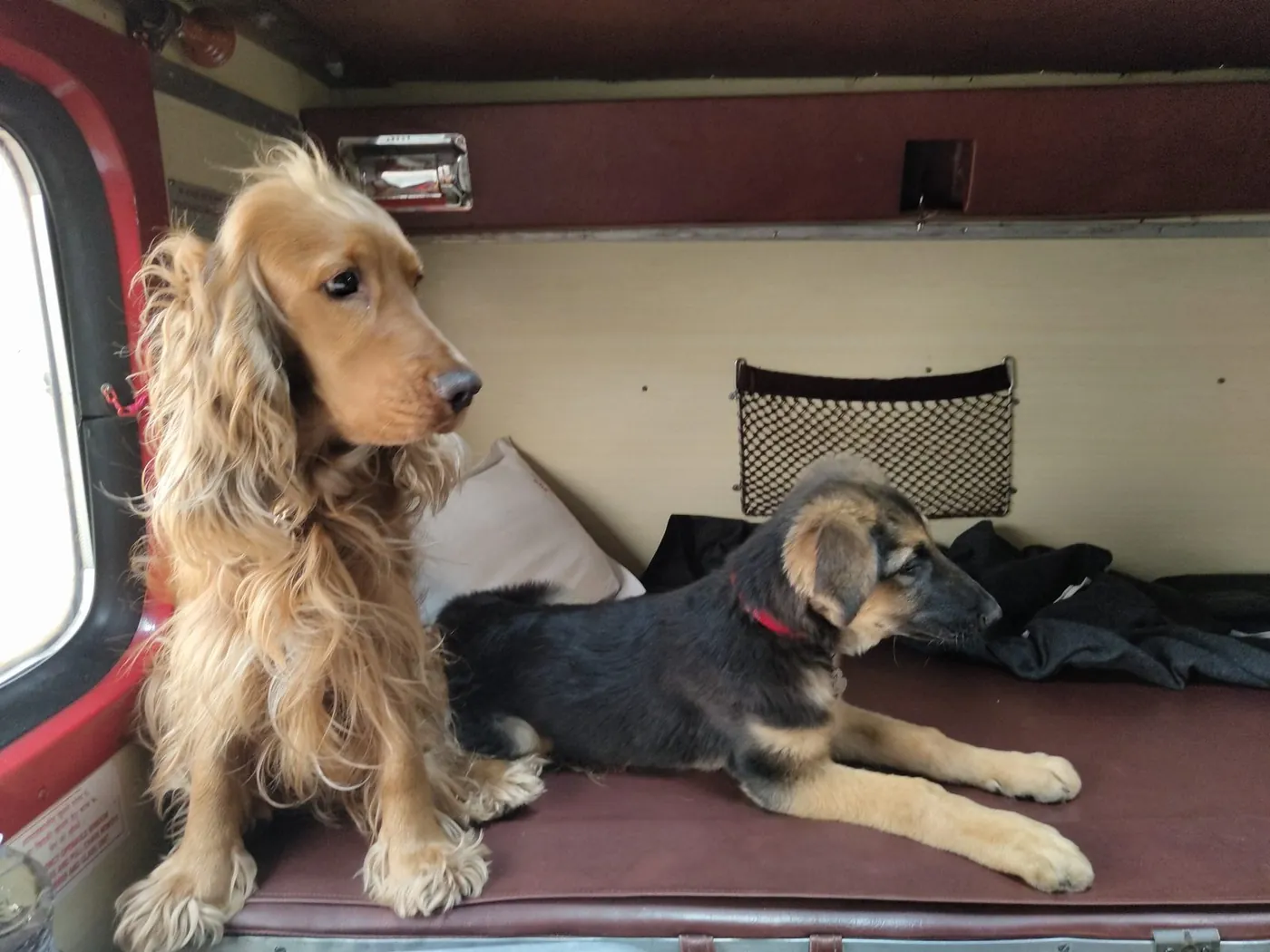
Dog travel training is not regular obedience with a suitcase.
A dog may sit beautifully in your living room and still panic in the car. A dog may come when called at home and still lose their brain when a stray appears near a homestay gate. A dog may be friendly in your building and still struggle when three new people approach at a resort reception.
That does not make the dog badly trained.
It means travel is a different environment with different pressures.
Roads, cars, fuel stops, cafés, farm stays, villas, hotel corridors, open gates, new smells, staff movement, other dogs, cattle, children, food smells, luggage chaos, and tired humans all change how a dog behaves.
Dog travel training prepares the dog-parent pair for that reality.
Not Instagram travel. Real travel. The kind where Google Maps lies, someone forgot the water bowl, your dog refuses to pee, and the property gate does not close properly.
Dog travel training is not regular obedience with a suitcase
Traditional obedience usually focuses on commands.
Sit. Stay. Down. Come. Heel.
These can be useful, but they are not the whole travel picture.
Travel readiness asks different questions:
- Can your dog settle in the car?
- Can your dog safely get in and out?
- Can your dog take a break near movement?
- Can your dog recover after seeing another dog?
- Can your dog rest in a new room?
- Can you guide your dog away from pressure?
- Can you read early signs of stress?
- Can you prevent one bad moment from becoming the story of the whole trip?
This is why many dog parents feel confused.
Their dog is not “untrained.” Their dog is underprepared for travel.
Different problem. Different solution.
Why Pune dog parents are asking this now
Pune is almost built for dog-parent road trips.
Within a few hours, you have Lonavala, Mulshi, Tamhini, Mahabaleshwar, Panchgani, Alibaug, Konkan routes, farm stays, villas, hill roads, heritage stays, monsoon drives, and long weekends where every human suddenly believes they are outdoorsy.
For dog parents, that sounds perfect.
Until the practical questions begin.
Will my dog handle the ghat section? Will she vomit? Will he bark at staff? Is the villa actually enclosed? What if there are strays? What if the room has slippery floors? What if my dog refuses to eat? What if I cannot manage him at a café stop?
This is exactly where travel training helps.
It bridges the gap between wanting to take your dog and actually being ready to do it safely.
What dog travel training helps with
Dog travel training should not be a random collection of tricks.
It should prepare the dog-parent pair for real travel situations.
Car travel
For some dogs, the car is exciting. For others, it is stressful. For some, it causes motion sickness. For some, it means the vet, grooming, or being left somewhere.
Car readiness may involve helping the dog feel safer around the car, enter and exit more calmly, remain in a safer travel position, reduce chaos during movement, and recover after the drive.
The exact work depends on the dog.
A dog who gets motion sick needs a different plan from a dog who barks at every biker.
Road breaks
Breaks are not simple.
A break may involve traffic, strangers, dogs, food, noise, slippery surfaces, open drains, cattle, and a parent trying to hold a leash while also paying for chai.
A travel-ready dog-parent pair needs a way to manage breaks without panic.
This includes safe exits, leash handling, distance from triggers, water breaks, toilet breaks, and returning to the car without negotiation worthy of Parliament.
New places
A new place can be thrilling or overwhelming.
Some dogs rush in. Some freeze. Some sniff everything and cannot settle. Some bark at every sound outside the room. Some stay awake all night because they are monitoring the universe.
Travel training helps you understand how your dog responds to new environments and what support they need to settle.
The goal is not to force the dog to “adjust.” The goal is to make adjustment possible.
People, dogs, staff, and movement
Travel exposes dogs to people who do not know them.
Caretakers, housekeeping staff, other guests, children, drivers, waiters, security guards, villagers, and dog lovers who approach with full confidence and zero consent.
Your dog may also encounter other dogs, strays, resident dogs, cats, cattle, goats, monkeys, or poultry depending on the property.
Dog travel training helps build management skills around these moments.
Not every dog needs to greet. Not every person needs to touch. Not every situation needs exposure. Sometimes the win is distance, calm exit, and zero drama. Very underrated. Highly useful.
Parent confidence
This is the part nobody talks about enough.
Travel readiness is not only about the dog. It is also about the parent.
Many parents are carrying quiet fear:
What if I cannot manage him? What if people judge me? What if she barks? What if he escapes? What if I chose the wrong place? What if this trip proves we should not travel with him?
Training should reduce that helplessness.
A prepared parent can make better decisions, read the dog sooner, ask properties better questions, and avoid situations the dog is not ready for yet.
Who needs dog travel training?
Dog travel training may be right for you if:
- You live in Pune and want to start road trips with your dog.
- Your dog is fine at home but different outside.
- Your dog struggles in the car.
- Your dog barks, lunges, freezes, or panics in new places.
- Your dog is excited but hard to manage on leash.
- Your dog is reactive to people, dogs, traffic, or animals.
- Your dog refuses food, water, or rest while travelling.
- You had one bad trip and do not want a repeat.
- You keep saving pet-friendly stays but never book.
- You are planning your first overnight stay with your dog.
- You want to travel but need a realistic readiness check first.
It is especially useful for medium and large dogs, young dogs, rescue dogs, anxious dogs, reactive dogs, first-time travellers, and parents who want to travel responsibly instead of winging it.
Winging it is fine for choosing snacks. Less fine when your dog is 25 kg, scared, and standing near an open gate.
Who may not need it yet?
You may not need a full travel readiness program if:
- Your dog already travels calmly.
- Your dog settles well in new places.
- You can safely manage your dog around people, dogs, and movement.
- You understand your dog’s stress signals.
- You have already completed multiple low-stress trips.
- You only need a one-off planning conversation before a specific trip.
You may also need foundational behaviour support before travel training if your dog is currently unsafe to handle outside, has a bite history, panics severely, or cannot be managed on leash at all.
That does not mean travel is impossible forever. It means the first goal may not be travel. The first goal may be safety and stability.
What Roadtrip Ready is
Roadtrip Ready is Dog Friendly India’s one-on-one Travel Readiness Training Program for dog-parent pairs in Pune.
It is built for people who want to travel with their dogs, but know that love and good intentions are not enough preparation.
The program helps the pair work toward safer, lower-stress travel through practical, force-free training and parent guidance.
It is designed for real Indian travel conditions: car rides, road breaks, new properties, staff interactions, unfamiliar dogs, outdoor spaces, and the planning decisions that happen before you even leave home.
Roadtrip Ready sits at the centre of DFI’s larger ecosystem: dogs ready for the road, parents ready to guide them, and properties becoming more dog-ready over time.
What Roadtrip Ready is not
Roadtrip Ready is not:
- A trick-training class.
- A generic obedience course.
- A guarantee that your dog will be perfect everywhere.
- A way to force your dog into situations they cannot handle.
- A property recommendation service.
- A boarding, walking, or pet-sitting service.
- A shortcut around veterinary care for motion sickness, pain, or health issues.
It is also not about shaming parents.
Most dog parents are trying hard. They are just trying inside a system that gives them vague listings, random advice, and too many “pets allowed” claims that collapse on arrival.
Roadtrip Ready gives structure.
How to decide if your dog is ready for the program
Start with these questions:
- What kind of travel do I want to do with my dog?
- What is difficult right now: car, leash, people, dogs, new places, settling, or my own confidence?
- Has my dog travelled before? What happened?
- Is there a specific trip coming up?
- Can my dog currently work around mild distractions?
- Is my dog physically well enough to travel?
- Am I ready to practise between sessions?
The best first step is not guessing.
It is a Travel Readiness Assessment.
That tells us where your dog is now, what you want travel to look like, and whether Roadtrip Ready is the right next step.
Ask if Roadtrip Ready is right for your dog
If you are in Pune and want to travel with your dog, you do not need to wait until you are fully confident.
Confidence comes from preparation.
Start with a conversation. Tell us about your dog, where you feel stuck, and what kind of travel you want to do together.
Dog. Parent. Property.
That is the whole picture.
Ask if Roadtrip Ready is right for your dog.
Tell us about your dog, where you feel stuck, and what kind of travel you want to do together.
Message DFI on WhatsAppFrequently asked questions
What is dog travel training?
Dog travel training prepares a dog-parent pair for real travel situations such as car rides, road breaks, unfamiliar places, new people, other dogs, and staying away from home.
Is dog travel training available in Pune?
Yes. Roadtrip Ready by Dog Friendly India is a one-on-one Travel Readiness Training Program for dog-parent pairs in Pune.
Is Roadtrip Ready only for dogs who have behaviour problems?
No. It is also for first-time travellers, young dogs, rescue dogs, anxious parents, and dog-parent pairs who want to prepare before a trip instead of waiting for something to go wrong.
Can travel training stop my dog’s motion sickness?
Training can help with stress and car associations, but repeated vomiting or suspected motion sickness should also be discussed with your vet. Some dogs need both behaviour support and medical guidance.
How do I know if my dog needs travel training?
If your dog struggles with the car, new places, leash control, people, dogs, settling, or your own confidence during travel, a Travel Readiness Assessment is a good starting point.